Treatment of Urologic Cancers
Systemic treatment of kidney, bladder, and prostate cancers. Treatment selection based on the molecular tumor profile, international guidelines, and clinical trial data.
Urologic Cancers: What You Need to Know
Urologic oncology encompasses malignant tumors of the urinary system and the male reproductive system: kidney cancer, bladder cancer, and prostate cancer. Together, these three sites account for approximately 15–18% of all malignancies in men.
Over the past decade, systemic treatment of urologic cancers has changed dramatically. The introduction of immune checkpoint inhibitors, new tyrosine kinase inhibitors, and next-generation antiandrogens has fundamentally expanded therapeutic options where previously there were few.
However, each of these tumors has its own biology, its own molecular targets, and its own logic of sequential therapy. The correct choice of first-line treatment and thoughtful planning of subsequent lines largely determines long-term outcomes.
Urologic oncology today is a field where molecular diagnostics and immunotherapy have changed the prognosis for thousands of patients. But this only works with the right sequence of decisions.

Key Urologic Cancer Types
The most common malignant kidney tumor in adults. Accounts for about 3% of all malignancies. Over 80% of cases are the clear cell subtype, driven by VHL gene inactivation with subsequent activation of angiogenesis.
Modern treatment: combinations of tyrosine kinase inhibitors (TKIs) with immune checkpoint inhibitors have become the first-line standard. In non-clear cell variants (papillary, chromophobe), the approach differs and requires separate justification.
Targeted + immunotherapyThe most common tumor of the urinary tract. Urothelial carcinoma can occur in the bladder, renal pelvis, ureter, and urethra. Key biomarkers: PD-L1 expression, FGFR status, homologous recombination deficiency (HRD).
Modern treatment: platinum-based chemotherapy remains the first-line standard. In recent years, checkpoint inhibitors (avelumab in maintenance), antibody-drug conjugates (enfortumab vedotin), and FGFR inhibitors (erdafitinib) for specific mutations have been approved.
Rapidly evolving fieldThe most common malignancy in men. Prostate cancer biology is determined by androgen dependence; however, over time the tumor may acquire castration resistance (mCRPC). It is at this stage that therapeutic decisions become most complex.
Modern treatment: next-generation antiandrogens (enzalutamide, abiraterone, darolutamide, apalutamide) are used in both hormone-sensitive and castration-resistant cancer. For BRCA1/2 and other DNA repair gene mutations (HRD), PARP inhibitors (olaparib, rucaparib) are indicated.
Hormonal + molecular therapyMolecular Diagnostics in Urologic Cancers
Molecular profiling in urologic cancers determines not only the first-line therapy choice but the entire sequential treatment strategy. This is especially important because different options exist for each line, and the order of their application affects the overall outcome.
We perform a comprehensive assessment of the tumor's biological characteristics before starting treatment. This allows immediate identification of the optimal approach and avoids prescribing ineffective regimens.
What is assessed during workup:
- Tumor histological subtype — clear cell vs non-clear cell kidney cancer, urothelial vs non-urothelial carcinoma
- PD-L1 expression — determines immunotherapy eligibility in bladder cancer
- FGFR2/3 mutations — in urothelial cancer for erdafitinib prescription
- BRCA1/2 and other HRD gene status — in prostate cancer to determine PARP inhibitor sensitivity
- Microsatellite instability (MSI-H) — immunotherapy eligibility regardless of tumor site
- PSA, alkaline phosphatase, and LDH levels — for risk stratification and regimen selection using IMDC/ISUP scales
Sequential Therapy Strategy
In urologic cancers, the correct sequence of treatment lines is critically important:
- Kidney cancer: TKI + immunotherapy combination in the first line; upon progression — switch to another TKI or mTOR inhibitor depending on prior treatment
- Bladder cancer: platinum-based chemotherapy, then maintenance avelumab; upon progression — enfortumab vedotin, erdafitinib for FGFR mutations
- Prostate cancer: early intensification of hormonal therapy; upon development of castration resistance — antiandrogen switch, chemotherapy, PARP inhibitors when indicated
Every decision is based on NCCN, ESMO, and RUSSCO guidelines with consideration of individual patient characteristics.
Systemic Treatment of Urologic Cancers
Each method is selected individually based on the tumor type, its molecular profile, disease stage, and the patient's overall condition.
Precise targeting of signaling pathways that drive tumor growth. In kidney cancer, the primary target is pathological angiogenesis driven by VHL gene inactivation.
Key agents: VEGFR tyrosine kinase inhibitors — sunitinib, pazopanib, cabozantinib, lenvatinib, axitinib. mTOR inhibitors — everolimus (upon TKI progression). Agent selection depends on the IMDC risk group and prior therapy.
Immune checkpoint inhibitors "release the block" on the immune system, allowing it to recognize and destroy tumor cells. Used in kidney cancer, bladder cancer, and in certain cases, in prostate cancer with MSI-H.
Key agents: nivolumab, pembrolizumab, avelumab. In kidney cancer — ipilimumab + nivolumab combination (for intermediate and poor-risk patients) or TKI + nivolumab/pembrolizumab. In urothelial cancer — avelumab in maintenance after chemotherapy.
Prostate cancer depends on androgens (male sex hormones). Androgen deprivation is the foundation of metastatic prostate cancer treatment. However, the modern approach involves early therapy intensification.
Key agents: next-generation antiandrogens — enzalutamide, abiraterone (+ prednisone), darolutamide, apalutamide. These agents, already in the first line for metastatic hormone-sensitive cancer, significantly improve overall survival compared to androgen deprivation alone.
Systemic cytotoxic therapy remains an important component of treatment for several urologic cancers, primarily urothelial cancer and castration-resistant prostate cancer.
For urothelial cancer: gemcitabine + cisplatin (or carboplatin when cisplatin is contraindicated) is the first-line standard. For prostate cancer: docetaxel and cabazitaxel are used upon hormonal therapy progression. Antibody-drug conjugates (enfortumab vedotin) represent a new drug class in urothelial cancer.
Expertise in Urologic Cancer Treatment

Dr. Ledin has over 20 years of experience in systemic treatment of malignant tumors, including the full spectrum of urologic cancers.
Experience working at major oncology centers and participation in international clinical trials provide deep understanding of both classical approaches and the newest therapeutic strategies in urologic oncology — from TKI + immunotherapy combinations in kidney cancer to PARP inhibitors in mCRPC.
Scientific Activities
- Over 60 scientific publications, including papers in leading international journals — Journal of Clinical Oncology (JCO), The Lancet Oncology
- Contribution to the development of national clinical guidelines for urologic cancer treatment
- Over 30 international clinical trials, including those for immunotherapy and targeted agents in kidney and bladder cancer
Professional Society Memberships
RUSSCO — Russian Society of Clinical Oncology. ESMO — European Society for Medical Oncology. ASCO — American Society of Clinical Oncology.
How to Start Treatment
From the first inquiry to the start of treatment — a clear and transparent process at every step.
You call or submit a request on the website. Our coordinator clarifies details, helps gather necessary documents and schedules a convenient consultation time.
The doctor reviews your medical history, examination results, and histology. If needed — additional workup is ordered: histology slide review, molecular genetic testing, and biomarker assessment.
Based on the complete workup, an individualized treatment plan is developed considering tumor type, molecular profile, stage, and overall condition. Every prescription is explained in detail — what, why, and what alternatives exist.
Treatment is provided in comfortable outpatient settings. At every stage — efficacy monitoring (CT, MRI, tumor markers) with timely therapy adjustments as needed.
Questions About Urologic Cancer Treatment
In kidney cancer, molecular testing begins with accurate determination of the histological subtype: clear cell, papillary, chromophobe, or rarer subtypes. This is critically important because treatment regimens differ for each.
For clear cell cancer, the key step is determining the prognostic risk group using the IMDC scale (International Metastatic Renal Cell Carcinoma Database Consortium), which takes into account clinical and laboratory parameters: hemoglobin, calcium, neutrophil, and platelet levels, time from diagnosis to treatment start, and performance status. This stratification determines the choice between various TKI + immunotherapy combinations and dual immunotherapy (ipilimumab + nivolumab).
In non-clear cell variants, expanded molecular genetic testing (NGS) may be indicated to search for potential targets (MET mutations, TFE3/TFEB translocations, etc.). MSI status is also determined to assess immunotherapy eligibility.
Yes, immunotherapy has established a firm position in the treatment of urothelial bladder cancer. Immune checkpoint inhibitors (anti-PD-1 and anti-PD-L1 antibodies) are used in several clinical settings.
Maintenance therapy: avelumab is prescribed after completion of platinum-based chemotherapy in the absence of progression. The JAVELIN Bladder 100 trial showed a statistically significant improvement in overall survival with this approach.
Second and subsequent lines: pembrolizumab and nivolumab are used upon progression after platinum-based chemotherapy, especially with high PD-L1 expression.
Additionally, fundamentally new drug classes have been approved in recent years: the antibody-drug conjugate enfortumab vedotin (targeting Nectin-4) and the FGFR inhibitor erdafitinib (for FGFR2/3 mutations or rearrangements), which have expanded therapeutic options in pretreated urothelial cancer.
Castration-resistant prostate cancer (CRPC, or mCRPC when metastatic) is a disease stage in which the tumor continues to progress despite castrate levels of testosterone (less than 50 ng/dL). This does not mean hormonal therapy has completely stopped working — the tumor has simply found mechanisms to bypass standard androgen deprivation.
Modern approaches to mCRPC treatment:
- Next-generation antiandrogens: enzalutamide, abiraterone — if not previously used during the hormone-sensitive stage
- Chemotherapy: docetaxel, cabazitaxel — upon progression on hormonal therapy
- PARP inhibitors: olaparib, rucaparib — when BRCA1/2 or other homologous recombination gene (HRD) mutations are present. HRD mutations are found in approximately 20–25% of mCRPC patients
- Radiopharmaceuticals: radium-223 — for bone metastases without visceral involvement; lutetium-177-PSMA — when PSMA expression is confirmed by PET-CT
The choice of specific therapy line depends on prior treatment, molecular tumor characteristics, metastasis locations, and the patient's overall condition.
Yes, I provide online consultations for patients from other cities or those who are unable to visit in person due to their health condition.
For an online consultation, all examination results, histological reports, and discharge summaries should be sent in advance. This allows the doctor to prepare and conduct the consultation as effectively as possible.
The online format is suitable for initial situation assessment, obtaining a second opinion, and treatment plan adjustments. To schedule an online consultation, contact us by phone at +7 (917) 520-45-89 or through the form on the website.
The initial consultation fee is 29,000 rubles.
The consultation includes a detailed review of all medical documentation, examination results, and histological reports. As a result, you receive:
- Assessment of the current situation and disease stage
- Recommendations for additional workup (if needed), including molecular genetic testing
- An individualized treatment plan with rationale for each prescription
- A sequential therapy strategy considering all possible treatment lines
- Answers to all your questions — as much time as needed
More details about pricing for all services — on the Pricing.
Schedule a Consultation
Tell us about your situation — we will help determine the next steps
Or contact us directly:
Related Articles and Sections
Blog Articles on Urologic Oncology
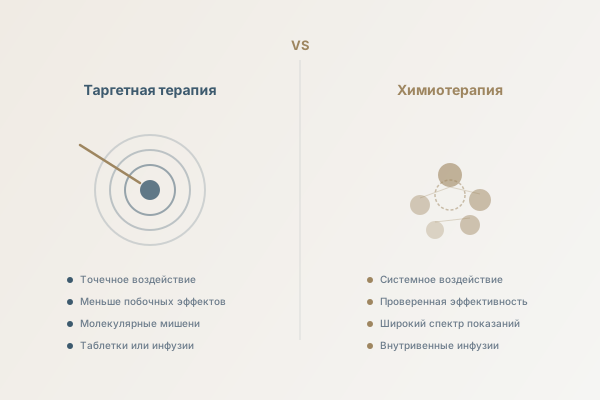
How targeted and immunotherapy combinations became the first-line standard and what to consider when choosing a regimen.
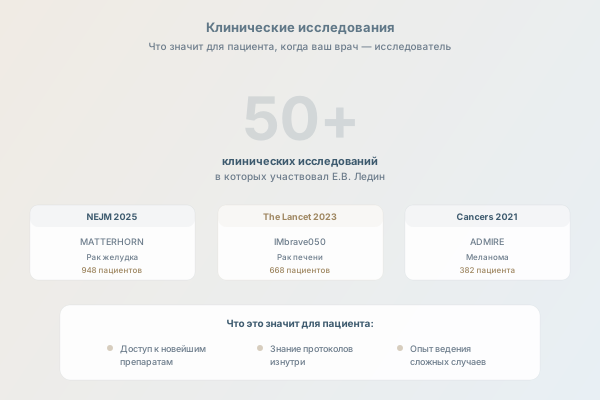
Next-generation antiandrogens, PARP inhibitors, radiopharmaceuticals — the sequence of decisions in castration-resistant prostate cancer.
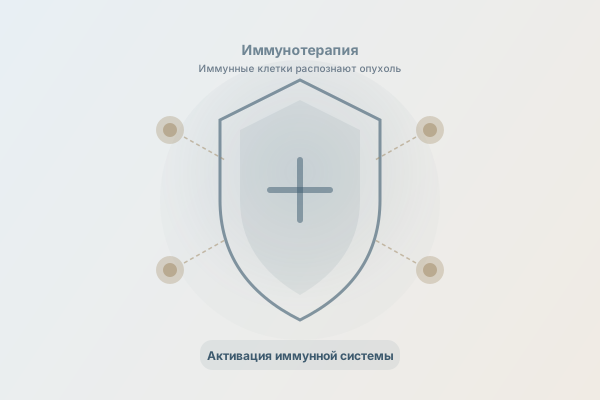
New drug classes — enfortumab vedotin, erdafitinib — and their place in the treatment algorithm for metastatic urothelial cancer.
Other Treatment Specialties
Treatment based on molecular subtype: luminal, HER2-positive, triple-negative. Targeted therapy and immunotherapy.
Learn more →Targeted therapy for BRAF mutations, checkpoint inhibitor immunotherapy. Modern combination regimens.
Learn more →Independent expert assessment of diagnosis and treatment plan. Verification of prescriptions based on international standards.
Learn more →