Treatment of Gastrointestinal Tumors
Systemic therapy for gastric, colorectal, pancreatic, and liver cancers. Treatment selection based on the molecular profile of the tumor and international clinical trial data.
What You Should Know About Gastrointestinal Tumors
Gastrointestinal malignancies encompass a group of cancers affecting the digestive system: the esophagus, stomach, small and large intestine, rectum, pancreas, liver, and biliary tract.
Colorectal cancer is the second most common malignancy in Russia. Despite declining incidence rates in recent decades, gastric cancer remains a significant challenge. Pancreatic cancer is characterized by its aggressive course and demands particular attention in treatment selection.
GI oncology has changed dramatically over the past decade. Molecular tumor profiling has become an essential part of diagnosis. Microsatellite instability (MSI) status, RAS and BRAF mutations in colorectal cancer, HER2 and PD-L1 expression in gastric cancer, BRCA mutations in pancreatic cancer — all of these determine treatment strategy.
GI tumors are not a single diagnosis. Each location and molecular subtype requires its own strategy. Accurate diagnostics determine treatment effectiveness.

Key GI Tumor Types
The most common GI tumor. Second most common malignancy in Russia. Molecular testing is mandatory: RAS (KRAS, NRAS), BRAF V600E, microsatellite instability (MSI/MMR), HER2 status.
Why it matters: in RAS wild-type left-sided tumors, anti-EGFR agents (cetuximab, panitumumab) are effective. In MSI-H cases, immunotherapy may be the first-line treatment. For BRAF V600E, the combination of encorafenib + cetuximab is indicated.
Molecular profile determines strategyRequires comprehensive molecular testing. HER2 expression, PD-L1 (CPS), MSI status, and Claudin 18.2 expression are assessed. Each of these markers opens possibilities for targeted or immunotherapy.
Modern approaches: for HER2+ cases, trastuzumab combined with chemotherapy. For PD-L1 CPS ≥5, first-line immunotherapy (nivolumab). The MATTERHORN clinical trial investigates perioperative immunotherapy for resectable gastric cancer.
Rapidly evolving fieldOne of the most aggressive tumors. Characterized by late diagnosis and treatment resistance. However, molecular testing can identify therapeutically significant targets: BRCA1/2 mutations, NTRK rearrangements, MSI-H.
What this means: for BRCA mutations, platinum-based agents and PARP inhibitors (olaparib) in maintenance mode become available. For NTRK rearrangements: larotrectinib, entrectinib. For MSI-H: immunotherapy. These are rare but clinically significant findings.
Molecular testing is essentialPrimary liver cancer. Most commonly develops in the setting of chronic liver disease: hepatitis B and C, cirrhosis, non-alcoholic steatohepatitis. Requires a multidisciplinary approach considering liver function (Child-Pugh score).
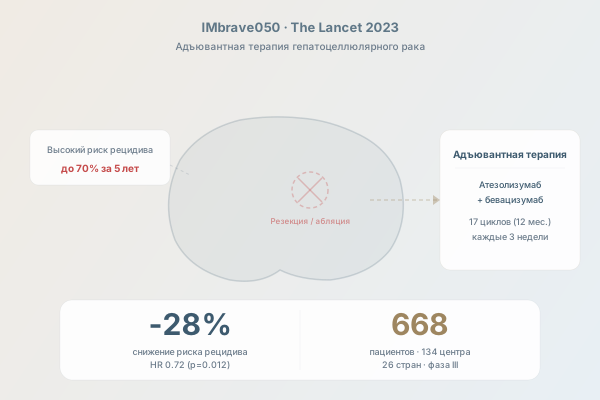
Treatment breakthrough: the combination of atezolizumab and bevacizumab (IMbrave150 trial) has become the new first-line standard for unresectable HCC. Dr. Ledin is a participant in the IMbrave050 trial, studying adjuvant immunotherapy after HCC resection.
IMbrave050 trial participantPrecision Oncology for GI Tumors
Precision oncology means that treatment selection is determined not only by tumor location and stage, but also by its molecular and biological characteristics. For GI tumors, this is particularly relevant — the same anatomical location may harbor fundamentally different biological diseases.
We determine the complete molecular profile of each tumor. This allows us to utilize the full arsenal of modern agents, including targeted therapy and immunotherapy, rather than relying solely on standard chemotherapy.
What is assessed during workup:
- Microsatellite instability status (MSI/MMR) — key predictor of immunotherapy response in all GI tumors
- RAS (KRAS, NRAS) and BRAF mutations — determine targeted therapy selection in colorectal cancer
- HER2 expression — enables anti-HER2 therapy in gastric and colorectal cancer
- PD-L1 expression (CPS) — determines immunotherapy eligibility as first-line treatment in gastric cancer
- BRCA1/2 mutations — enable PARP inhibitor therapy in pancreatic cancer
- NTRK, RET rearrangements, gene fusions — rare but therapeutically significant targets
Clinical Trial Participation
Dr. Ledin is a participant and investigator in several international clinical trials in GI oncology. This provides access to the latest data and the ability to apply cutting-edge approaches in clinical practice.
- IMbrave050 — adjuvant immunotherapy with atezolizumab + bevacizumab after resection or ablation of hepatocellular carcinoma at high risk of recurrence
- MATTERHORN — perioperative immunotherapy with durvalumab combined with FLOT chemotherapy for resectable gastric and gastroesophageal junction cancer
- Over 30 international trials across various cancer types, including Phase III studies in colorectal and pancreatic cancer
Every therapeutic decision is based on clinical trial data and international guidelines (NCCN, ESMO, RUSSCO).
Systemic Therapy for GI Tumors
Treatment selection is determined by tumor location, stage, molecular profile, and the patient's overall condition. A combination of approaches is often most effective.
Remains the backbone of systemic treatment for most GI tumors. Combinations based on fluoropyrimidines (5-fluorouracil, capecitabine), oxaliplatin, irinotecan, platinum agents, gemcitabine, and nab-paclitaxel are used.
Key regimens for GI tumors: FOLFOX, FOLFIRI, XELOX for colorectal cancer. FLOT for gastric cancer (perioperative therapy). FOLFIRINOX, gemcitabine + nab-paclitaxel for pancreatic cancer. Regimen selection is individualized.
Precise targeting of tumor molecular drivers. Significantly expands treatment options for GI tumors. Each targeted agent is prescribed strictly based on molecular testing results.
Key targets and agents: anti-EGFR (cetuximab, panitumumab) for RAS wild-type colorectal cancer. Anti-HER2 (trastuzumab) for HER2+ gastric cancer. Anti-VEGF (bevacizumab) for colorectal cancer and HCC. Encorafenib + cetuximab for BRAF V600E colorectal cancer.
Activation of the antitumor immune response. In GI tumors, immunotherapy has shown significant efficacy in several clinical settings and continues to be actively studied in clinical trials.
When indicated: for MSI-H/dMMR, pembrolizumab can be first-line therapy for colorectal cancer (KEYNOTE-177). For gastric cancer with PD-L1 CPS ≥5: nivolumab + chemotherapy (CheckMate 649). For HCC: atezolizumab + bevacizumab (IMbrave150). For esophageal cancer: nivolumab, pembrolizumab.
Combining multiple systemic treatment modalities is a key principle of modern GI oncology. Combining chemotherapy with targeted or immunotherapy agents often improves treatment efficacy.
Examples of combinations: FOLFOX + bevacizumab or cetuximab for metastatic colorectal cancer. Trastuzumab + chemotherapy for HER2+ gastric cancer. Atezolizumab + bevacizumab for HCC. FLOT + durvalumab under investigation for gastric cancer (MATTERHORN). Combination selection is strictly individualized.
Expertise in GI Tumor Treatment

GI tumors are Dr. Ledin's primary specialization. This is the field in which he has worked throughout his 20+ year clinical career.
Dr. Ledin is a co-author of RUSSCO national clinical guidelines for the treatment of gastrointestinal tumors. This means direct participation in developing treatment standards used by oncologists across Russia.
Scientific Activities in GI Oncology
- Co-author of RUSSCO clinical guidelines for gastrointestinal tumors
- Over 60 scientific publications, including works in The Lancet, The Lancet Oncology, Journal of Clinical Oncology (JCO), New England Journal of Medicine (NEJM)
- Investigator in IMbrave050 (adjuvant HCC therapy) and MATTERHORN (perioperative gastric cancer immunotherapy)
- Participation in over 30 international clinical trials
Professional Society Memberships
RUSSCO — Russian Society of Clinical Oncology. ESMO — European Society for Medical Oncology. ASCO — American Society of Clinical Oncology.
How to Start Treatment
From your first inquiry to the start of treatment — a clear and transparent process at every step.
You call or submit a request on the website. Our coordinator clarifies details, helps gather necessary documents (histology reports, test results, discharge summaries) and schedules a convenient consultation time.
The doctor thoroughly reviews the medical history, morphological and molecular test results. If molecular testing has not been done or is incomplete, the necessary tests are ordered.
Based on the complete molecular tumor profile, disease stage, comorbidities, and patient preferences, an individualized treatment plan is developed. Every prescription is explained in detail — why, how, and what alternatives exist.
Treatment is provided in comfortable outpatient settings. At every stage, efficacy is monitored (CT scans, laboratory tests, tumor markers) with timely therapy adjustments as needed.
Questions About GI Tumor Treatment
The following molecular tests are mandatory for colorectal cancer:
- RAS mutations (KRAS, NRAS) — determine eligibility for anti-EGFR therapy (cetuximab, panitumumab). With RAS mutations, these drugs are ineffective and potentially harmful.
- BRAF V600E mutation — found in approximately 8-10% of patients. Has unfavorable prognostic significance but enables the encorafenib + cetuximab combination.
- MSI/MMR status — microsatellite instability (MSI-H) or mismatch repair deficiency (dMMR). Found in 5-15% of patients. This is the key predictor of immunotherapy response. In metastatic MSI-H colorectal cancer, pembrolizumab may be prescribed as first-line therapy.
- HER2 — overexpression or gene amplification. Determines eligibility for anti-HER2 therapy (trastuzumab deruxtecan).
In certain cases, comprehensive genomic profiling (NGS) is performed to identify rare but therapeutically significant targets: NTRK and RET rearrangements, MET amplification.
Yes, chemotherapy is the primary systemic treatment for pancreatic cancer. Two main regimens are used:
- FOLFIRINOX (5-fluorouracil, leucovorin, irinotecan, oxaliplatin) — the most effective regimen but also the most toxic. Prescribed for patients with good performance status (ECOG 0-1).
- Gemcitabine + nab-paclitaxel — an alternative regimen with acceptable toxicity. Used when FOLFIRINOX cannot be prescribed.
However, molecular testing is important. Approximately 5-7% of pancreatic cancer patients carry BRCA1/2 mutations — in such cases, after achieving a response to platinum-based chemotherapy, maintenance therapy with olaparib (PARP inhibitor) is possible, which extends progression-free survival.
In rare cases (less than 1%), MSI-H or NTRK rearrangements are identified, opening the possibility for immunotherapy or targeted agents, respectively.
Immunotherapy for gastric cancer involves drugs that activate the patient's own immune system to fight the tumor. It is based on immune checkpoint blockade — drugs that release the "brakes" on the immune system.
The landmark CheckMate 649 trial demonstrated that in gastric cancer with high PD-L1 expression (CPS ≥5), adding nivolumab to first-line chemotherapy significantly improves overall survival compared to chemotherapy alone.
Immunotherapy has also shown efficacy:
- In MSI-H gastric cancer: pembrolizumab
- In third and subsequent lines: nivolumab
- In the perioperative setting: under investigation in the MATTERHORN trial (durvalumab + FLOT)
PD-L1 (CPS) and MSI/MMR testing is mandatory to determine immunotherapy eligibility.
Dr. Ledin has extensive experience participating in international clinical trials as a principal investigator. Over the course of his clinical practice, he has participated in over 30 Phase II and III clinical trials.
Among the most significant GI oncology trials:
- IMbrave050 — international Phase III trial of adjuvant immunotherapy (atezolizumab + bevacizumab) after resection or ablation of high-risk hepatocellular carcinoma
- MATTERHORN — Phase III trial of perioperative immunotherapy (durvalumab + FLOT) for resectable gastric and gastroesophageal junction cancer
The results of these trials have been published in leading medical journals — The Lancet, NEJM, JCO — and Dr. Ledin is a co-author of these publications.
Clinical trial participation not only provides access to innovative drugs but also builds a deep understanding of modern treatment approaches that are applied in daily clinical practice.
The initial consultation fee is 29,000 rubles.
The consultation includes a detailed review of all medical documentation, test results, histological and molecular studies. As a result, you receive:
- Assessment of the current situation: stage, extent, molecular profile
- Recommendations for additional testing if molecular profiling is incomplete
- An individualized treatment plan with rationale for each prescription
- Answers to all your questions — with no time limit
More details about pricing for all services on the Pricing.
Other Specialties
Schedule a Consultation
Tell us about your situation — we will help determine the next steps
Or contact us directly:
Related Articles and Sections
Blog Articles on GI Tumors

Why molecular testing has become mandatory in colorectal cancer and how test results determine therapy selection.

How immunotherapy eligibility is determined, what PD-L1 CPS is, and the results of the CheckMate 649 trial.
From sorafenib to the atezolizumab + bevacizumab combination: how HCC treatment has evolved over the past decade.
Other Treatment Specialties
Breast cancer treatment by molecular subtype: hormonal therapy, targeted therapy, immunotherapy, chemotherapy.
Learn more →Melanoma systemic therapy: immunotherapy, targeted therapy for BRAF mutations, combination regimens.
Learn more →Independent expert assessment of diagnosis and treatment plan. Verification of prescriptions based on international standards.
Learn more →