Treatment of Gynecologic Cancers
Systemic treatment of ovarian, cervical, and uterine cancers. Molecular diagnostics including BRCA, HRD, MSI, and PD-L1 determine the individualized treatment strategy.
What You Should Know About Gynecologic Cancers
Gynecologic oncology encompasses malignant tumors of the female reproductive system: ovarian cancer, cervical cancer, and endometrial (uterine) cancer. Each of these diseases has its own biology, molecular profile, and treatment approach.
In recent years, the understanding of molecular mechanisms in gynecologic cancers has fundamentally changed. Testing for BRCA1/2 mutations, HRD status, microsatellite instability (MSI), and PD-L1 expression has become an integral part of diagnosis and determines the systemic treatment strategy.
Molecular diagnostics have opened access to next-generation targeted agents — PARP inhibitors, immune checkpoint inhibitors, and anti-angiogenic drugs — which have significantly improved treatment outcomes in many forms of gynecologic cancers.
Modern treatment of gynecologic cancers is impossible without molecular profiling. BRCA, HRD, MSI, and PD-L1 status determines access to the most effective agents.

Key Gynecologic Cancer Types
The most serious gynecologic cancer in terms of prognosis. High-grade serous ovarian cancer is the most common histological subtype (up to 70%). Often diagnosed at advanced stages due to the absence of early symptoms.
Key molecular markers: BRCA1/2 mutations (germline and somatic — up to 20–25% of cases), HRD status (homologous recombination deficiency — up to 50%), which determines sensitivity to PARP inhibitors and platinum-based agents.
BRCA / HRD — key to treatmentIn the vast majority of cases, it is associated with the human papillomavirus (HPV). Squamous cell carcinoma accounts for about 70–80% of cases, adenocarcinoma — 20–25%. In advanced forms, systemic therapy plays a key role.
Key molecular markers: PD-L1 expression (CPS) determines the possibility of immunotherapy (pembrolizumab). Adding immunotherapy to chemotherapy and bevacizumab has been shown to significantly improve survival in metastatic and recurrent cervical cancer.
PD-L1 and immunotherapyThe most common gynecologic malignancy. Four molecular subtypes are identified according to the TCGA classification: POLE-ultramutated, MSI-H/dMMR, TP53-mutant, and non-specific (NSMP). Each has a different prognosis.
Key molecular markers: microsatellite instability MSI-H / mismatch repair deficiency dMMR (up to 25–30% of cases) — indication for immunotherapy. POLE mutation — extremely favorable prognosis. Estrogen and progesterone receptors — determine the possibility of hormonal therapy.
TCGA molecular classificationA group of rare tumors arising from trophoblastic tissue. Includes hydatidiform mole, invasive mole, choriocarcinoma, and placental site trophoblastic tumor. Monitored by beta-hCG levels.
Treatment features: high sensitivity to chemotherapy — one of the few solid malignancies with the possibility of complete cure even in metastatic forms. Methotrexate, actinomycin D, EMA-CO — the primary regimens.
Highly curableHow Gynecologic Cancer Treatment Strategy Is Developed
Molecular diagnostics are the foundation of treatment. Without determining BRCA status in ovarian cancer, MSI in endometrial cancer, and PD-L1 in cervical cancer, a patient may not gain access to the most effective agents.
We determine the complete molecular tumor profile before starting systemic treatment. This allows selection of the optimal strategy, including the possibility of targeted therapy and immunotherapy.
What is assessed during workup:
- BRCA1/2 mutations (germline and somatic) — indication for PARP inhibitors in ovarian cancer
- HRD status (homologous recombination deficiency) — extended indication for PARP inhibitors
- Microsatellite instability (MSI-H / dMMR) — indication for immunotherapy in endometrial cancer
- PD-L1 expression (CPS) — indication for pembrolizumab in cervical cancer
- POLE mutation — prognostic factor in endometrial cancer
- Estrogen and progesterone receptors (ER/PR) — determine the possibility of hormonal therapy in endometrial cancer
How the Molecular Profile Affects Treatment Selection
Molecular diagnostic results determine:
- Ovarian cancer, BRCA+ or HRD+ — maintenance therapy with PARP inhibitors (olaparib, niraparib) after chemotherapy, significantly improving progression-free survival
- Ovarian cancer, BRCA− / HRD− — bevacizumab combined with chemotherapy and in maintenance
- Cervical cancer, PD-L1+ — pembrolizumab + chemotherapy + bevacizumab in the first line
- Endometrial cancer, MSI-H / dMMR — immunotherapy (dostarlimab, pembrolizumab) as monotherapy or combined with chemotherapy
- Endometrial cancer, ER+ — possibility of hormonal therapy under certain conditions
Every prescription is based on randomized clinical trial results and follows NCCN, ESMO, and RUSSCO guidelines.
Systemic Treatment of Gynecologic Cancers
Each method is selected individually based on the molecular tumor profile, disease stage, and the patient's clinical situation.
Remains the foundation of systemic treatment for gynecologic cancers. Platinum-based regimens (carboplatin + paclitaxel) are the first-line standard for ovarian and cervical cancers.
For ovarian cancer: carboplatin + paclitaxel followed by maintenance therapy. For cervical cancer: carboplatin/cisplatin + paclitaxel + bevacizumab. For endometrial cancer: carboplatin + paclitaxel. Platinum sensitivity is the key prognostic factor in ovarian cancer.
PARP inhibitors are a breakthrough in ovarian cancer treatment. They block the PARP enzyme involved in DNA repair, leading to the death of tumor cells with defects in the homologous recombination system (BRCA+, HRD+).
Agents used: olaparib, niraparib — in maintenance after response to platinum-based chemotherapy. Bevacizumab (anti-angiogenic agent) — inhibits the formation of new blood vessels feeding the tumor, used in ovarian and cervical cancers.
Immune checkpoint inhibitors activate the body's own antitumor immunity. In gynecologic oncology, immunotherapy has established a firm position in cervical cancer and MSI-H endometrial cancer.
Agents used: pembrolizumab — in PD-L1-positive cervical cancer (combined with chemotherapy and bevacizumab) and in MSI-H endometrial cancer. Dostarlimab — in dMMR/MSI-H endometrial cancer. Combinations of immunotherapy with chemotherapy in endometrial cancer regardless of MSI status are being investigated.
Used in certain forms of endometrial cancer. When estrogen and progesterone receptors are present, especially in well-differentiated endometrioid adenocarcinoma, hormonal therapy can be effective.
Agents used: megestrol acetate, medroxyprogesterone acetate, aromatase inhibitors (letrozole), tamoxifen. Hormonal therapy may be used as a standalone method in early-stage endometrial cancer in young patients wishing to preserve fertility — strictly under specific conditions and with careful monitoring.
Expertise in Gynecologic Cancer Treatment

Dr. Ledin has over 20 years of experience in systemic treatment of malignant tumors, including all forms of gynecologic cancers.
Clinical experience in gynecologic oncology covers the full spectrum of diseases — from primary systemic treatment to therapy of recurrent and resistant forms of ovarian, cervical, and uterine cancers.
Scientific Activities
- Over 60 scientific publications in leading international and Russian oncology journals, including the Journal of Clinical Oncology (JCO) and The Lancet Oncology
- Participation in over 30 international clinical trials, including those for innovative agents in gynecologic oncology
- Contribution to the development of national clinical guidelines
Professional Society Memberships
RUSSCO — Russian Society of Clinical Oncology. ESMO — European Society for Medical Oncology. ASCO — American Society of Clinical Oncology.
How to Start Treatment
From the first inquiry to the start of treatment — a clear and transparent process at every step.
You call or submit a request on the website. Our coordinator clarifies details, helps gather necessary documents and schedules a convenient consultation time.
The doctor reviews your medical history, histology results, imaging data, and molecular testing. If BRCA, MSI, or PD-L1 testing has not yet been performed — it is ordered as a priority.
Based on the complete molecular tumor profile, disease stage, and clinical picture, an individualized treatment strategy is developed. Every prescription is discussed in detail — why, what the rationale is, and what alternatives exist.
Treatment is provided in comfortable outpatient settings with regular efficacy monitoring (CT, CA-125 and HE4 markers) and side effect management. If needed — timely regimen adjustments.
Questions About Gynecologic Cancer Treatment
BRCA1 and BRCA2 gene mutations are found in 15–25% of ovarian cancer patients. These genes encode proteins involved in repairing damaged DNA through the homologous recombination mechanism.
When a BRCA mutation is present, tumor cells cannot effectively repair their DNA. PARP inhibitors (olaparib, niraparib) take advantage of this — they block an alternative repair pathway, leading to the accumulation of a critical amount of DNA damage and tumor cell death.
Clinical trials have convincingly shown that maintenance therapy with PARP inhibitors in patients with BRCA mutations significantly improves progression-free survival. Moreover, the presence of a BRCA mutation indicates increased tumor sensitivity to platinum-based agents.
Important: testing is performed for both inherited (germline) and acquired (somatic) mutations. When a hereditary mutation is identified, genetic counseling for family members is recommended.
PARP (poly ADP-ribose polymerase) is an enzyme involved in repairing single-strand DNA breaks. When this enzyme is blocked by a PARP inhibitor, single-strand breaks convert into double-strand breaks.
In normal cells, double-strand DNA breaks are repaired by the homologous recombination (HR) system. But in tumor cells with a BRCA mutation or HR deficiency (HRD), this mechanism does not work. As a result, DNA damage accumulates and the cell dies. This is called "synthetic lethality."
Currently in gynecologic oncology, olaparib and niraparib are used — primarily in maintenance after response to first- or second-line platinum-based chemotherapy in ovarian cancer. The greatest efficacy is observed with BRCA1/2 mutations, but some benefit is also seen with HRD-positive status without a BRCA mutation.
Yes, immunotherapy has become an important component of advanced cervical cancer treatment. The pivotal KEYNOTE-826 trial showed that adding pembrolizumab to chemotherapy (with or without bevacizumab) in the first-line treatment of metastatic and recurrent cervical cancer significantly improves overall and progression-free survival in patients with PD-L1-positive tumors (CPS ≥ 1).
To determine immunotherapy eligibility, PD-L1 expression in the tumor must be assessed with calculation of the CPS (Combined Positive Score). When CPS ≥ 1, pembrolizumab is added to standard chemotherapy.
Additionally, pembrolizumab can be used in second and subsequent lines for MSI-H/dMMR tumors (although this is uncommon in cervical cancer). Other immuno-oncology approaches are also being actively studied.
Surgical treatment (hysterectomy with adnexectomy and lymph node dissection) remains the standard for endometrial cancer. However, in strictly defined situations, an organ-preserving approach with hormonal therapy is possible.
This is permissible when several conditions are simultaneously met: well-differentiated endometrioid adenocarcinoma (G1), tumor confined to the endometrium (no myometrial invasion on MRI), presence of estrogen and progesterone receptors, young age with desire to preserve fertility, and no contraindications to hormonal therapy.
This approach requires careful patient selection, regular monitoring (hysteroscopy with biopsy every 3 months), and the understanding that after completing fertility goals, surgical treatment is recommended. The decision is always made by a multidisciplinary team.
The initial consultation fee is 29,000 rubles.
The consultation includes a detailed analysis of all medical documentation, histological examination results, and molecular testing. As a result, you receive:
- Assessment of disease stage and tumor molecular profile
- An individualized treatment strategy with rationale for agent selection
- Recommendations for additional testing (BRCA, HRD, MSI, PD-L1), if not yet performed
- Answers to all your questions — as much time as needed
More details about pricing for all services — on the Pricing.
Schedule a Consultation
Tell us about your situation — we will help determine the next steps
Or contact us directly:
Related Articles and Sections
Blog Articles on Gynecologic Oncology
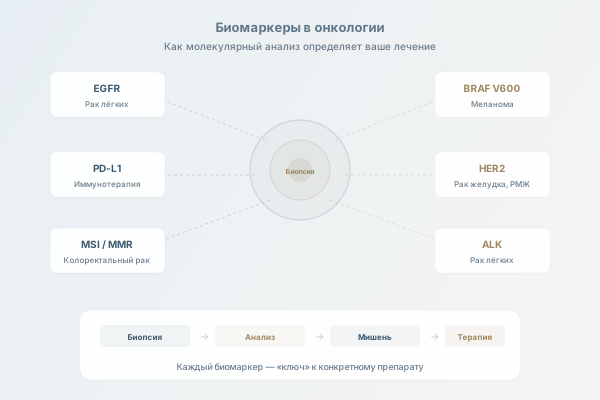
How determining BRCA status changes the treatment strategy and opens access to PARP inhibitors.

How pembrolizumab changed treatment standards for advanced cervical cancer — KEYNOTE-826 data.

POLE, MSI-H, TP53, and NSMP — why the molecular subtype of endometrial cancer matters more than stage for treatment selection.
Other Treatment Specialties
Treatment of all molecular breast cancer subtypes: targeted therapy, immunotherapy, hormonal therapy, chemotherapy.
Learn more →BRAF/MEK targeted therapy, immunotherapy. Participation in the ADMIRE clinical trial.
Learn more →Independent expert evaluation of diagnosis and treatment plan based on international standards.
Learn more →