Cancer Second Opinion
A second opinion is not a sign of distrust. It is a standard international practice recommended by all leading oncology societies. Available in-person and online.
When a Cancer Second Opinion Is Truly Important
Seeking a second opinion is not a sign of distrust toward your treating physician. It is a standard international practice, especially in oncology, where the accuracy of initial decisions shapes the entire prognosis.
In oncology, diagnostic errors or suboptimal first-line therapy choices can have serious consequences. According to peer-reviewed studies, up to 10–15% of histological diagnoses are revised upon expert re-review (Kronz JD et al., 1999), and treatment recommendations change in approximately 30–40% of cases after a second opinion (Mellink WAM et al., 2006).
This does not mean the first doctor made a mistake. Often it is a matter of access to a full range of diagnostic capabilities, knowledge of current international guidelines, and experience with the specific tumor type.
A second opinion is not doubt — it is responsibility. In complex clinical situations, it can change the strategy and, consequently, the treatment outcome.

When to seek a second opinion
Especially if the diagnosis was made for the first time, if the histology report raises questions, or if you have a rare tumor type. Expert pathology review at a reference laboratory can refine the diagnosis, change the subtype, or restage the disease.
If the treatment regimen seems outdated. If you have read about other options for your disease. If no one explained why this specific regimen was chosen and what alternatives exist.
Rare histological subtypes, unusual metastatic patterns, multiple primary tumors. In such situations, standard protocols may not fully apply, and a physician with experience in the specific disease and access to current clinical data is essential.
If you are facing a major surgery, prolonged high-dose chemotherapy, or treatment with severe side effects. An independent expert review can confirm that this is truly the optimal path or suggest a less aggressive alternative.
What a Cancer Second Opinion Includes
A comprehensive expert assessment with a detailed written report.
Review of the histological report. If needed, recommendation for pathology re-review at a reference laboratory. Assessment of staging completeness: whether all necessary tests have been performed and whether the stage is correctly determined.
Why it matters: errors in histological subtype or stage directly affect treatment selection. The difference between T2 and T3, between N0 and N1, can mean a fundamentally different approach.
Analysis of the prescribed regimen for alignment with current international guidelines (NCCN, ESMO, RUSSCO). Assessment of whether more effective or less toxic options exist for your specific clinical case.
Why it matters: guidelines are updated several times a year. A regimen that was the standard a year ago may now be replaced by a more effective one. This is especially true for immunotherapy and targeted therapy.
If the current approach is suboptimal, alternative regimens with rationale are proposed. If molecular testing has not been performed, specific tests and their clinical significance are recommended. Assessment of eligibility for clinical trials.
Why it matters: patients should know all their options — from standard to experimental. This is especially important for pretreated or recurrent tumors where standard options may be exhausted.
After the consultation, you receive a detailed document: clinical case summary, diagnosis and staging assessment, current treatment plan analysis, therapy recommendations with evidence base (references to clinical trials and guidelines).
Why it matters: a written report is a working document that you can show to your treating physician. It contains specific recommendations, not general phrases, and enables informed decision-making.
How to Get a Second Opinion
In-Person Consultation in Moscow
Duration: 45–60 minutes. Includes a personal appointment with a detailed review of all documents, examination if needed, strategy discussion, and answers to your questions.
The optimal format if you are in Moscow or can travel. In-person contact allows for a more thorough discussion of every aspect of your situation.
Online Consultation
Conducted via video call for patients from other cities and countries. The duration and scope of expertise are the same as an in-person consultation.
Documents are submitted electronically in advance. The doctor reviews them before the consultation, so the entire meeting time is dedicated to discussion, not reading records.
What Documents to Prepare
- Discharge summaries from medical institutions where you were examined and treated
- Histology report (if available, bring slides and blocks for possible re-review)
- Molecular test results (IHC, FISH, NGS — if performed)
- Imaging data: CT, MRI, PET-CT (disc with actual images, not just written reports)
- Laboratory results: CBC, biochemistry, tumor markers
- Operative notes (if surgery was performed)
What You Will Receive
Regardless of format (in-person or online), the consultation outcome includes:
- Expert diagnosis assessment — confirmation or recommendations for further workup
- Treatment plan analysis — alignment with international standards
- Recommendations — specific strategy proposals with rationale
- Written report — detailed document (provided within 2–3 business days after consultation)
- Answers to your questions — as much time as needed to understand the situation
The report can be used as a working document for discussion with your treating physician. I do not replace your doctor — I help you and your doctor make the most informed decision.
Second Opinion in International Practice
Seeking a second opinion is not a sign of distrust. It is a standard part of cancer care in developed countries.
Studies published in Annals of Surgical Oncology and other leading journals show that upon expert re-review of histological specimens, the diagnosis is revised in 10–15% of cases (Kronz JD et al., Am J Surg Pathol, 1999). Changes may involve histological subtype, grade, or resection margin status.
According to data from major cancer centers (MD Anderson, Memorial Sloan Kettering), treatment recommendations change in approximately 30–40% of cases after a second opinion (Mellink WAM et al., Ann Oncol, 2006). Changes range from minor dose adjustments to complete strategy revisions.
Not all medical facilities perform comprehensive molecular testing. A second opinion can assess whether the necessary diagnostic workup has been done and whether potential molecular targets for targeted therapy or immunotherapy have been missed.
Even if the second opinion confirms the prescribed treatment, that is a valuable result in itself. The patient begins therapy knowing the right choice was made, which reduces anxiety and improves treatment adherence.
Why Patients Seek a Second Opinion from Dr. Evgeny Ledin

Dr. Ledin has the qualifications necessary for an independent expert assessment of complex oncology cases.
Two decades in systemic treatment of a wide range of malignancies. This is important for a second opinion because the expert must deeply understand the biology of the specific disease and current therapeutic approaches.
What ensures the quality of the review
- Publications in JCO, The Lancet Oncology and other leading international journals — over 60 scientific papers, reflecting continuous engagement with the global research community
- Participation in more than 30 international clinical trials — knowledge of not only current standards but also emerging approaches
- Chair of RUSSCO Working Group for clinical guidelines (small bowel cancer, 2025), co-author of liver tumor guidelines — expert-level understanding of therapeutic decision-making
- Membership in RUSSCO, ESMO, ASCO — real-time access to guideline updates
How to Get a Second Opinion
Four steps from initial inquiry to receiving an expert report.
Contact us by phone, WhatsApp, or through the form on this page. The coordinator will explain what documents are needed and help you collect them. You send discharge summaries, test results, and histology reports electronically.
The doctor reviews all submitted materials before the consultation. If needed, additional information is requested. By the time of the meeting, the doctor is fully immersed in your clinical situation.
In-person meeting at the clinic or online video session. Discussion of the diagnosis, assessment of the current treatment plan, review of alternatives. Answers to all of your questions.
Within 2–3 business days, you receive a detailed document: expert diagnosis assessment, treatment plan analysis, specific recommendations with evidence base. A document you can share with your treating physician.
Second Opinion FAQ
The key is to gather the most complete set of medical documents possible. The more information the doctor has, the more precise and useful the review will be.
Essential minimum:
- Hospital discharge summaries and outpatient records
- Histology (pathology) report
- IHC (immunohistochemistry) results
- CT/MRI/PET-CT — ideally disc images, not just written reports (descriptions can be subjective)
- Lab tests: CBC, biochemistry, tumor markers
Also helpful:
- Molecular/genetic testing results (NGS, FISH), if performed
- Operative notes
- Histology slides and paraffin blocks (for possible re-review)
If some documents are missing, that is not a reason to postpone. The doctor will assess the situation based on available data and specify what additional workup is needed.
Yes, online consultations for second opinions are available for patients from any city in Russia or abroad. Format: video call via a secure platform.
The quality of the online review is equal to an in-person visit, since the main work — document analysis — is done by the doctor before the meeting. The consultation time is devoted to discussing conclusions, strategy, and answering questions.
To schedule an online consultation, contact us by phone +7 (917) 520-45-89, via WhatsApp, or through the form on this page.
Slides and paraffin blocks are the original biological material from which the histology report was prepared. Having them allows for a potential pathology re-review at a reference laboratory.
When slides are especially important:
- With rare histological subtypes, where diagnostic disagreement is more likely
- With borderline IHC results (e.g., equivocal HER2 status)
- If additional molecular/genetic testing is needed (which requires tumor tissue)
If you have the slides and blocks, bring them or send them in advance. If they are difficult to obtain, come with what you have. The doctor will advise whether a re-review is needed and how to obtain the material from the medical facility.
The written report is provided within 2–3 business days after the consultation.
This time is needed for the doctor to formulate recommendations as precisely as possible: verify the relevance of cited clinical trials, ensure the accuracy of dosages and regimens, and format the document in a structured manner.
If the situation requires urgent action (e.g., treatment must begin within days), please let us know when scheduling — I will do my best to expedite the process.
The consultation fee for a second opinion is 29,000 RUB (approx. $290). This includes:
- Pre-consultation review of all submitted medical documents
- Consultation (45–60 minutes) — in-person or online
- Written report with detailed recommendations (within 2–3 business days)
Additional tests (histology re-review, molecular/genetic testing) are billed separately if needed. Their cost is discussed in advance.
For more information about all services, visit the Services page.
Get a Cancer Second Opinion
Having doubts is not distrust of your doctor. It is a natural response to a difficult situation. Send your documents — we will review them together.
I will personally review your medical records before the appointment to make the consultation as productive as possible.
Or contact us directly:
Related Sections
Treatment Specialties
Treatment based on molecular subtype: luminal, HER2-positive, triple-negative. Targeted therapy and immunotherapy.
Learn more →Treatment of kidney, bladder, and prostate cancer. Targeted therapy, immunotherapy, hormone therapy.
Learn more →Treatment of gastric, colorectal, pancreatic, and liver cancers. Precision approach guided by molecular profiling.
Learn more →Blog Articles
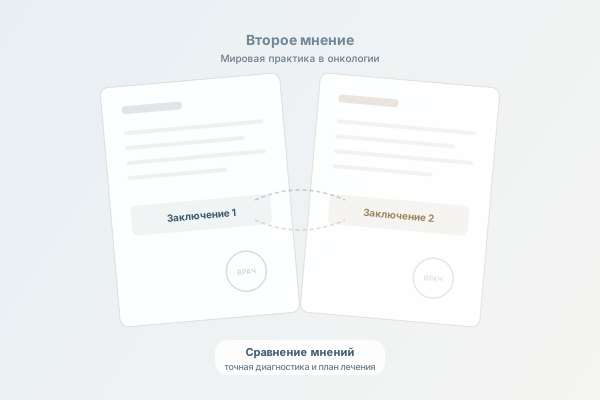
Real clinical cases where a second opinion changed the diagnosis, treatment strategy, or prevented unnecessary intervention.
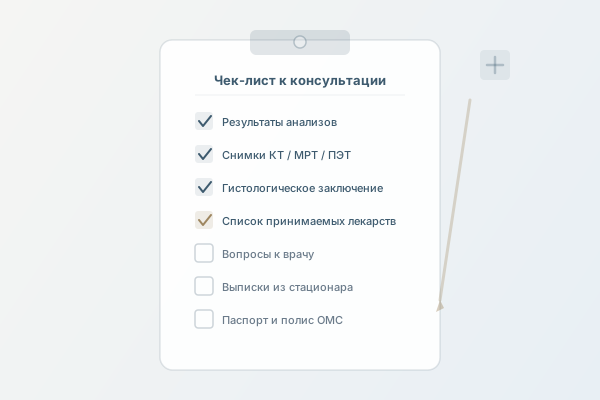
Which documents to gather, what questions to ask, and how to make the most of your doctor visit.
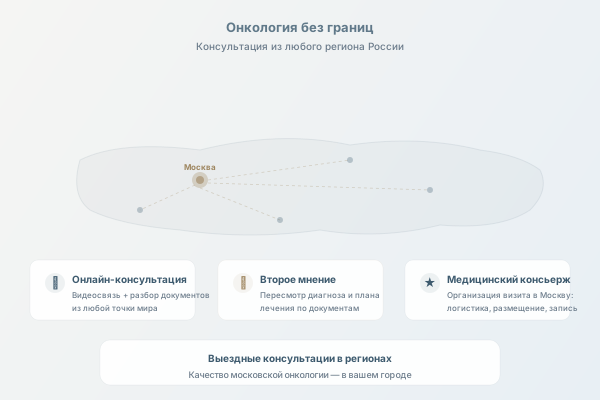
How molecular/genetic testing changes diagnoses and opens new therapeutic possibilities.